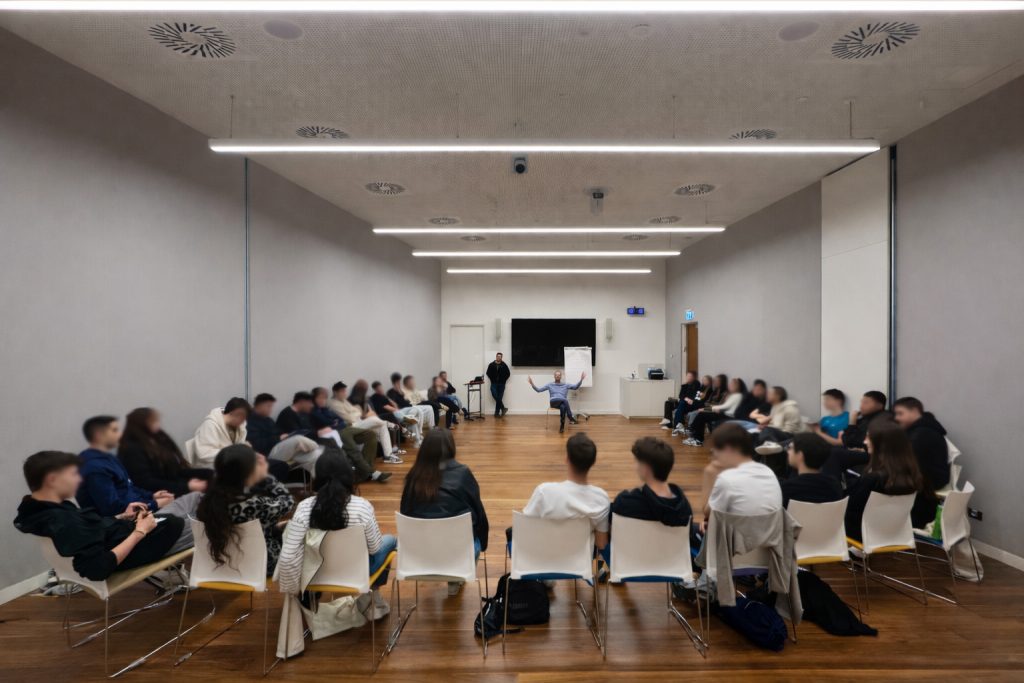
The program is grounded in a wide range of sources, from the Jewish textual tradition and the culture of the Beit Midrash, through philosophical thought, to contemporary social and political issues. Its aim is to develop awareness, knowledge, and skills for engaging in dialogue between differing perspectives, enabling meaningful and enriching debate that does not seek uniformity of opinion, but rather the flourishing of multiple voices.
The emphasis is placed on mapping areas of agreement and disagreement, maintaining a shared conversational space, and preventing escalation into hostility, polarization, and exclusion. Participants are also provided with practical tools for engaging with the challenges of media, social networks, and contemporary social conflict.
Three workshop-based study days are offered, focusing on navigating disagreement:
Day 1 | Between Conflict and Plurality of Views
Day 2 | Experiencing the Beit Midrash Method of Disagreement
Day 3 | You Are Invited to Disagree
Day 1: Between Conflict and Plurality of Views
This day is dedicated to a deeper exploration of the Jewish Talmudic tradition of disagreement and to examining disagreement as a social, value-based, and political phenomenon, in both its constructive and potentially destructive dimensions.
Throughout the day, participants consider the risks inherent in disagreement and the processes through which it may deteriorate into conflict, division, and violence, alongside an exploration of the Beit Midrash foundations of pluralism and multiple perspectives. Psychological and digital factors that shape opinions and intensify polarization are also examined, as well as the ethics of disagreement and public discourse, including questions of moral responsibility, the pursuit of truth, freedom of thought and expression, demagoguery, and illegitimate interests.
The day includes interpretive and applied exercises that enable participants to approach phenomena from multiple perspectives, identify points of risk within disagreement, and construct appropriate frameworks for managing it. Participants engage in developing ethical guidelines for defining and navigating disagreement, with the aim of strengthening both individual and collective capacity to engage in disagreement without undermining shared space.
Optional: A Jerusalem tour that explores historical and social disagreements in the city, “Between Hillel and Shamai.”
Day 2: Experiencing the Beit Midrash Method of Disagreement
This day is dedicated to an in-depth experiential practice of the Beit Midrash method for managing disagreement, which views disagreement not only as a challenge but also as an opportunity. Throughout the day, participants become familiar with the principles of the method and with ways of engaging in disagreement in a constructive and responsible manner that prevents escalation into division while enabling growth and learning.
Participants develop the ability to identify points of difficulty during disagreement, understand its cultural and social roots, and create a safe space for engaging with complex dialogue.
The day is based on intensive practice, simulations, and discussion grounded in real disagreements, while integrating principles, rules, and techniques for asking questions, mapping areas of agreement and disagreement, and facilitating constructive dialogue.
By the end of the day, participants are able to consider how the method can be applied in personal, educational, and public contexts, based on the understanding that well-managed disagreement can strengthen social resilience and sustain a vibrant democratic space.
Day 3: You Are Invited to Disagree
The Hebrew word “to disagree” (לחלוק) carries a dual meaning: separation and division, but also sharing and the creation of a shared space. This seminar seeks to examine this duality and to explore how disagreement can be transformed from a source of polarization and division into a social, civic, and cultural asset. Inspired by the Jewish understanding of disagreement as a productive framework for dialogue, the seminar focuses on developing the ability to foster complex and respectful dialogue in communities, classrooms, workplaces, families, and on social media.
The day begins with introductions and group formation, and with framing the challenge of addressing polarization in Israeli democratic society, alongside an introduction to the mission of the Museum of Tolerance Jerusalem and the School of Civic Discourse. It then explores the Jewish conception of disagreement, the distinction between constructive and destructive disagreement, and the ways in which a culture of disagreement has developed in Israel over time.
A central part of the seminar is dedicated to building a safe and ethical space for engaging in disagreement. Participants learn principles, tools, and guidelines that enable the expression of differing views while maintaining responsibility, respect, and clear boundaries of discourse, even in the face of challenges posed by media and social networks.
The seminar combines practical exercises in managing disagreement in face-to-face and digital settings, while distinguishing between personal responsibility and social influence. By the end of the day, participants explore concrete ways to embed a culture of disagreement in their immediate environments and online spaces, based on the understanding that well-managed disagreement is a vital foundation for social resilience and for living together in a diverse and pluralistic society.
Jerusalem Tours
City Walks and Guided Tours
As part of the workshops, unique walking tours in the area surrounding the Museum of Tolerance Jerusalem can be integrated into the program. These tours lead participants through the city’s alleys and key landmarks, dovetailing with the School’s curriculum and integrating in-depth content, creative guided facilitation, and a lived experience of the city.
The tours function as an open learning environment, enabling connections between abstract ideas and everyday reality, between theory and human interaction, and between conceptual discussion and lived experience in the city. Through walking, observation, and experiencing the city first-hand, participants gain a deeper understanding of complex issues, while encouraging curiosity and engagement with contemporary social and cultural questions.
The tours are also available as a standalone activity, without participation in a full seminar day. Three different tours are currently offered, focusing on disagreement, the formation of Jewish, Jerusalem and Israeli identities, and lived stories of tolerance, conflict, and coexistence in the city.
The duration of all tours is approximately two to three hours, and they are intended for high school students, teachers and education professionals, community leaders, university students, tourists, and other diverse audiences seeking to engage with Jerusalem through a social, cultural, and values-based lens.
Among the tours offered:
Between Hillel and Shammai
This flagship tour of the School of Civic Discourse takes place between Hillel Street and Shammai Street, a symbolic meeting point for the tradition of disagreement in Jewish thought and its contemporary Israeli context.
Throughout the tour, key disagreements from Jewish, Israeli, and Jerusalem history are examined, many of which remain highly relevant today. Through various stops in the city, participants explore the difference between disagreement “for the sake of heaven,” which enables pluralism and constructive dialogue, and disagreement that leads to extremism, exclusion, and division.
The tour addresses, among other topics, debates from the era of the Sanhedrin, relations between Hasidim and Mitnagdim, between Zionism and religion, religious and secular communities, the Hebrew language, ethnic gaps, and the tension between tradition and modernity. Each topic is examined from a historical perspective combined with a contemporary social reading.
The tour combines walking, dialogue, and observation, allowing participants to engage with complex ideas within a living experience in Jerusalem.
Between Madness and Greatness in the Big City
This tour follows one of Jerusalem’s most fascinating phenomena, the so-called “Jerusalem Syndrome,” and explores the fine line between passion, madness, and greatness. Throughout history, Jerusalem has served as a place of pilgrimage, inspiration, and psychological upheaval, a city that people have “fallen in love with” and, at times, been overwhelmed by.
The tour examines this dynamic through figures who lived in the city and left their mark on it. Some were considered mad in their time, only to have their greatness recognized later, while others were acknowledged during their lifetimes. All lived, worked, or are commemorated in areas around the museum.
Through their stories, the tour raises questions about the elusive boundary between madness and greatness, between harmful non-conformity and creative innovation. It invites reflection on the level of social tolerance required to accommodate unconventional and pioneering figures, alongside a critical examination of situations in which “madness” becomes perceived as a social threat.
The tour connects Jerusalem’s history with the present, examining contemporary phenomena of leadership, expertise, and influence, including the relationship between truth and falsehood, experts and influencers, and the ways charismatic figures shape consciousness in both public and digital spaces.
Stigma in Jerusalem – Pride and Prejudice
This tour examines the prejudices and stereotypes often attributed to communities and individuals in Jerusalem and in Israeli society more broadly. Within less than a kilometer from the Museum of Tolerance, diverse communities and populations coexist, many of which are defined externally through fixed labels and perceptions.
The tour departs from the Museum of Tolerance Jerusalem, which promotes pluralism and equality, and invites participants to critically reflect on questions of identity, belonging, and exclusion. Throughout the walk, participants examine the origins of stereotypes, the mechanisms through which we define ourselves by marking “the other,” and the possibility of challenging deeply embedded perceptions.
Through encounters with human and local stories, the tour offers new perspectives on Jerusalem and its communities, encouraging critical thinking and curiosity. It becomes a process of deconstructing and reconstructing perspectives, grounded in the understanding that reality is more complex than the narratives we are accustomed to telling ourselves.
This tour is often combined with the workshop “A Journey Betwe Identity,” which deepens the exploration of personal, collective, and social identities.